Watching an eclipse: what you actually risk, and how to protect yourself
A solar eclipse is a magnificent and fascinating sight, but it carries a risk for the eyes. In France, during the eclipse of 11 August 1999, 147 people damaged their retina, 17 of them severely — and 37 owned approved glasses that they took off. How do you watch a solar eclipse safely? And what do you actually risk?
By Ludovic Debono · published 10 September 2026
The essentials, if you read nothing else
Never look at the Sun with the naked eye, not even when three quarters of it are covered, not even for a second.
You need glasses bearing the CE marking and the words EN ISO 12312-2, bought from a seller you can identify.
Not sunglasses, not smoked glass, not X-ray film, not a compact disc, not a phone screen.
The one exception: you take your glasses off during totality, but only if you are inside the path of totality. The moment the first sliver of Sun returns, the protection goes back on.
The injury does not hurt. It appears hours later. What you feel at the time tells you nothing at all.
Why it does not hurt
The retina has no pain receptors, and you can destroy irreplaceable cells while feeling nothing worse than ordinary dazzle.
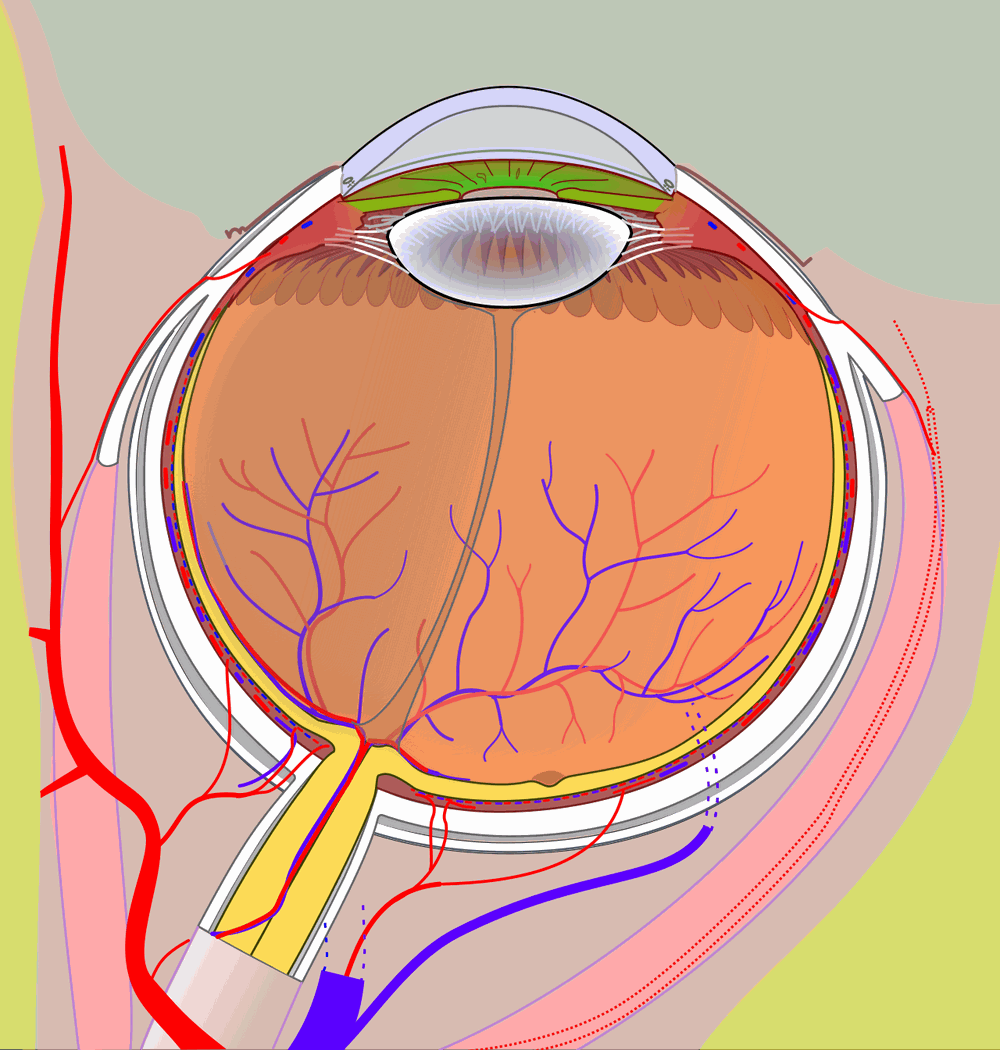
Two mechanisms are at work. The eye is naturally protected against part of the solar spectrum — the cornea and the lens block ultraviolet below 380 nanometres and infrared beyond 1,400 nanometres. Between those two limits, everything gets through, and the lens concentrates that beam onto a few tenths of a square millimetre of central retina. There it produces both a photochemical reaction — a cascade of oxidation in the photoreceptor cells — and heating, as the absorbed light turns into warmth1.
The eye in cross-section. Light enters through the cornea, at the top, passes through the lens, which concentrates it, and strikes the retina at the back — on the macula, the area of fine vision. That is what the Sun burns. Diagram Jmarchn, CC BY-SA 3.0.
It does not take long. Less than a minute of unprotected viewing is enough to cause such damage. And glancing briefly, several times over, protects you from nothing: the insults add up. Children are more exposed than adults, because their ocular media transmit more light.
The first signs appear a few hours later, sometimes several days: a dark patch at the centre of the visual field, lines that ripple, a drop in acuity. In 1999, slightly more than half the patients consulted within forty-eight hours of the eclipse. The lesion may fade slowly, or leave a permanent loss.
One case published in 2018 in JAMA Ophthalmology travelled the world of ophthalmology: in a woman in her twenties who had glanced a few times at the 2017 American eclipse without protection, retinal imaging showed a lesion shaped like a crescent — the exact shape of the bitten Sun she had looked at, printed into her cells2.
What you actually risk, with figures
In France, the survey carried out after the total eclipse of 11 August 1999 by the Institut de veille sanitaire and the ophthalmology departments of the Pitié-Salpêtrière hospital recorded 147 solar retinopathies, 17 of them severe, with acuity down to 2/10 or worse, and 7 of those in both eyes3. The injured were in no way reckless by temperament: the median age was 29, the most affected age group was 15 to 29, and there were as many women as men.
In the United Kingdom, the same eclipse, total over Cornwall, gave rise to a survey of ophthalmologists across the country: 70 cases of visual loss, an average age of 29.5, the same as in France, and no lasting loss of vision at six months4. At the eye casualty department in Leicester, of the 45 people who came in after the eclipse, 5 had a visible retinal lesion and 4 were still troubled seven months later. The patients seen again 21 months after the eclipse had recovered normal vision5.
In the United States, a study covering a network of more than a million patients counts 555 solar retinopathies between 2012 and 2024, with a clear peak in the year of the eclipse of 21 August 20176. In Utah, one department saw 27 people worried about their sight after that eclipse, 6 of whom did have a lesion7.
Those figures read both ways. Set against the tens of millions of people who watched those eclipses, they say the accident is rare. Set against the 17 people whose central vision was permanently reduced, they say it is real.
Who was injured, exactly
This is where the French report becomes valuable, because it asked patients how they had watched.
Of 133 documented cases, 80% had watched the eclipse with the naked eye. But that figure covers two very different situations:
69 people watched with no protection at all.
37 people had glasses and took them off during the observation.
The rest divides between nine pairs of ordinary sunglasses, five welding filters, and six assorted means — photographic film, prescription lenses, tinted glass. And only four patients report having used compliant glasses correctly.
That last figure is the most important in the whole report. It means that approved glasses, worn as they should be, kept their promise. The problem was never the filter: it was the act of taking it off.
One can see why. A partial eclipse, seen through an eclipse filter, is an austere sight — an orange crescent on a perfectly black background, no landscape, no sky, nothing else. The temptation to check "with your own eyes" what you are seeing is immense, and it is exactly what must not be done. Note too that three quarters of those injured had watched for less than five minutes in total.
What the standard requires
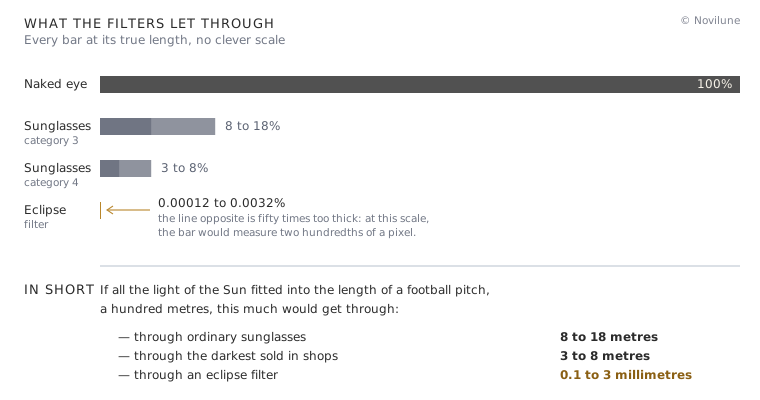
An eclipse filter is not a tinted lens. The international standard ISO 12312-2, which governs filters for direct solar viewing, requires a visible light transmittance between 0.00012% and 0.0032%8.
In other words: between one millionth and one thirty-thousandth of the light may pass. A pair of category 3 sunglasses, the kind you take to the beach, lets through around 10% — tens of thousands of times more. They are not inadequate: they are beside the point.
The standard also sets limits for ultraviolet and infrared, and these are not the same depending on whether you look with the naked eye or through an instrument. In 1998, ahead of the 1999 eclipse, the Académie nationale de médecine had expressed the same requirement in its own vocabulary: an optical density of 5 or more, meaning an attenuation by a factor of at least a hundred thousand9.
Every bar is at its true length. The eclipse filter's would measure two hundredths of a pixel — it cannot be drawn, and that is precisely the point. If all the light of the Sun fitted into the length of a football pitch, three millimetres of it would get through.
Who does the checking, and in which countries?
This is the part that changes everything about how you buy.
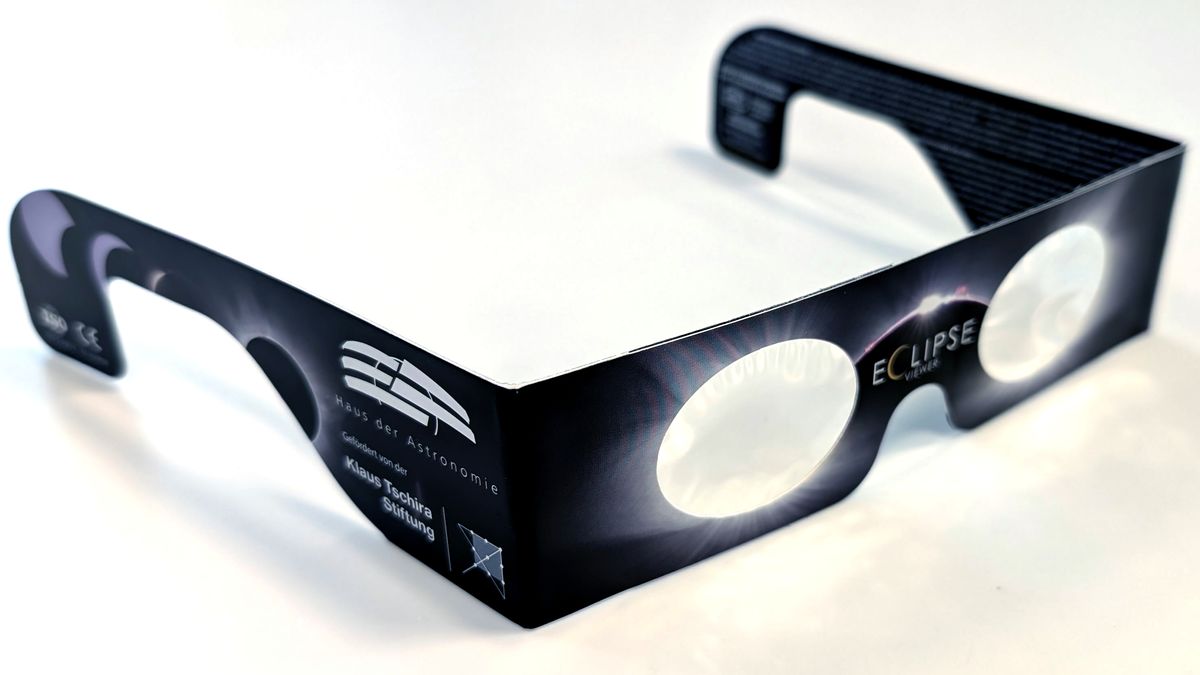
In Europe, eclipse glasses are legally personal protective equipment, governed by Regulation (EU) 2016/42510. A manufacturer cannot put them on sale without having them examined by a notified body — an independent, officially designated laboratory. The CE marking is therefore not a commercial label: it is the trace of a legal check carried out beforehand. The product or its instructions must also carry the identity of the manufacturer and the importer, a batch reference, the standard applied and the precautions for use, in the language of the country of sale.
The CE mark and the ISO logo, printed on the arm: that is where they belong. Glasses commissioned by the Haus der Astronomie in Heidelberg for the eclipse of 12 August 2026 and distributed to schools in the region. Photo Markus Nielbock, CC BY 4.0.
In the United States, no equivalent obligation exists. Anyone can print "ISO 12312-2" on a sleeve. This is why the American Astronomical Society maintains a public list of suppliers whose products have been tested by an accredited laboratory, and adds a manufacturer to it only on presentation of a verified test report11.
The AAS insists in passing on a point that is often misunderstood: you cannot be "ISO certified". The International Organization for Standardization writes standards, it certifies no product. Packaging that announces "ISO certified" mostly shows that its manufacturer has not read what ISO writes about its own name.
In the United Kingdom, Brexit changed nothing for the buyer. The European regulation on personal protective equipment was carried over into British law as it stood, and a national marking, UKCA, was created alongside the CE marking. But the British government recognises the CE marking with no end date, either on its own or beside its own12. A pair bought in France is therefore valid in Great Britain, and the other way round. In Northern Ireland, which has remained aligned with European rules, the CE marking applies, either alone or alongside a UKNI marking.
Does it follow that the European consumer can relax? No, and the facts have shown it twice. In 1999, 4.4 million pairs had to be withdrawn from the French market a few days before the eclipse, part of the batches not being compliant13. In August 2026, the Association Française d'Astronomie referred to the consumer protection authorities the case of glasses sold at newsstands whose actual compliance could not be verified14.
The good news came in the same month: the consumer magazine Que Choisir had ten models from the shops tested by a laboratory. All of them filtered solar radiation correctly. What several of them lacked were the mandatory markings — manufacturer's name, importer's details, instructions in French15. A traceability failure, not a protection failure.
The practical rule that follows is simple: buy only from someone you can call back — an identifiable seller, instructions in your own language, a named manufacturer. If the product has no address, it has no history.
Makeshift methods, one by one
Every one of those below was used by people who were injured in 1999.
Sunglasses, however dark, however many pairs stacked: they let through tens of thousands of times too much light, and above all they remove the discomfort that would make you look away.
Smoked glass, photographic film, X-ray film: they dim the visible without stopping the infrared. You see nothing, and you cook all the same.
A compact disc, a phone screen, the bottom of a bottle: no defined optical properties, no checks, no reason whatever to trust them.
Welding glass is the only recognised alternative, provided it is shade 12 to 16, which is not the shade of an ordinary DIY mask. The Académie de médecine already accepted it in 199816. Below shade 12, it is dangerous.
One rule apart, and it is essential: with binoculars, a spotting scope or a telescope, the filter goes in front of the objective, never at the eyepiece. A filter placed behind receives all the light concentrated by the instrument, heats up and can crack in a fraction of a second, with the eye right behind it. Eclipse glasses are not to be worn behind an instrument either: they are made for the naked eye. And setting out to observe an eclipse with an optical instrument calls for solid knowledge of the subject beforehand.
The one moment when you can look
During totality, and on that condition alone, the protection comes off. The solar disc is entirely covered, the corona appears, and it is the one sight in the sky that can only be seen with the naked eye — an eclipse filter would make it invisible.
Three points, because this is the most delicate moment:
This holds only inside the path of totality. Ten kilometres from the edge, a thread of photosphere remains, and that thread is enough to injure.
This does not hold for an annular eclipse. The ring is Sun, as dangerous as a whole disc. At no point during an annular eclipse does the protection come off.
The protection goes back on at the first flash. The light returns abruptly, in a second or two, and that is precisely when the retina, dilated by the gloom, is at its most vulnerable.
Knowing whether you are inside the path, and for how long, is not a matter of feeling. The city pages of this site give, for each place, the duration of totality to the second and a map of the nearest path. The Novilune app can also give this information for anywhere on the globe.
Other safe methods
Indirect methods carry no risk at all, and show things a filter does not.
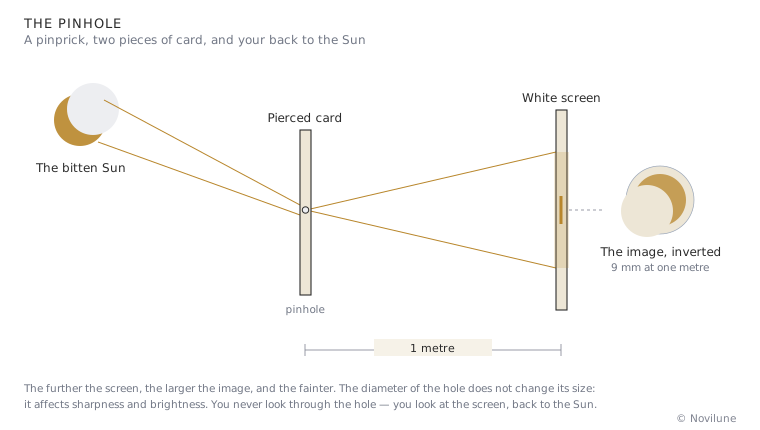
The pinhole is the simplest: make a pinprick in a piece of card, turn your back to the Sun, and let the image form on a second card held a metre behind. You see the crescent live. The smaller the hole, the sharper and the dimmer the image.
The pinhole, in cross-section. The rays cross at the hole, and the image arrives inverted on the screen. Its size depends only on the distance — one hundredth of it, so nine millimetres at one metre — and not on the diameter of the hole, which affects only sharpness. You look at the screen, with your back to the Sun.
Projection through an instrument means letting binoculars or a small telescope form the image on a white screen, without ever putting your eye behind it. It requires watching the instrument, which can heat up quickly.
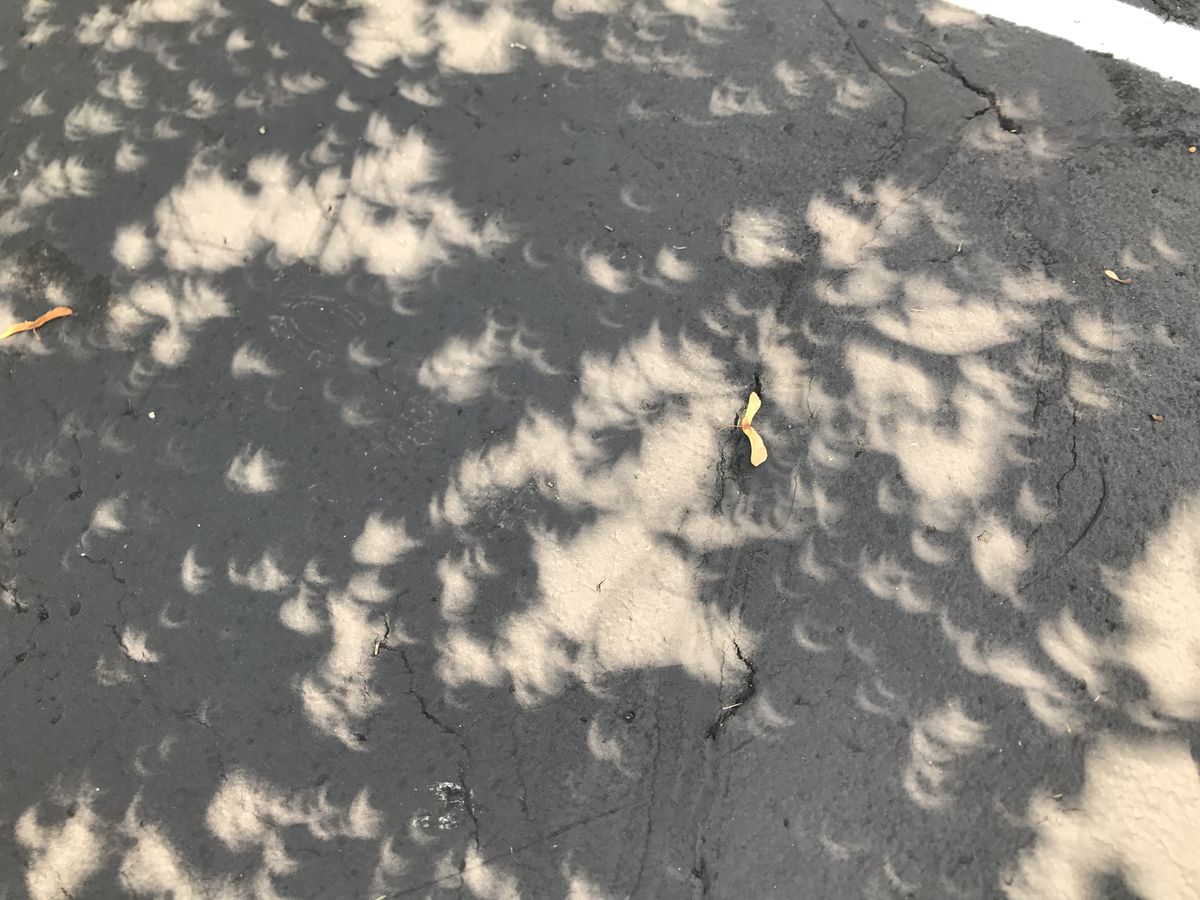
And there is the loveliest one, which is often forgotten: the shade of foliage. Every gap between the leaves acts as a pinhole, and the ground under a tree becomes covered with hundreds of crescents. It is by far the best way to show a partial eclipse to children.
Under a tree during the eclipse of 21 August 2017 in Pittsburgh. Every gap in the foliage projects a crescent, and the ground holds hundreds of them. Photo Benjamin Seigh, CC BY-SA 4.0.
Astronomers have injured themselves too
Legend has it that Galileo went blind from looking at the Sun. It is false. His blindness, which came late, is explained by a cataract and a glaucoma, and the attribution to the Sun appears to go back to Lalande, in the eighteenth century17. The same correction applies to Cassini.
What is documented is more interesting. In February 1612, Thomas Harriot notes after a solar observation that "my sight was after dim for an houre". The mathematician John Greaves, who was measuring the diameter of the Sun, was long left seeing what he described as "a company of crows flying together in the air".
And above all Newton, whose account is all the more valuable for being an answer to a precise question.
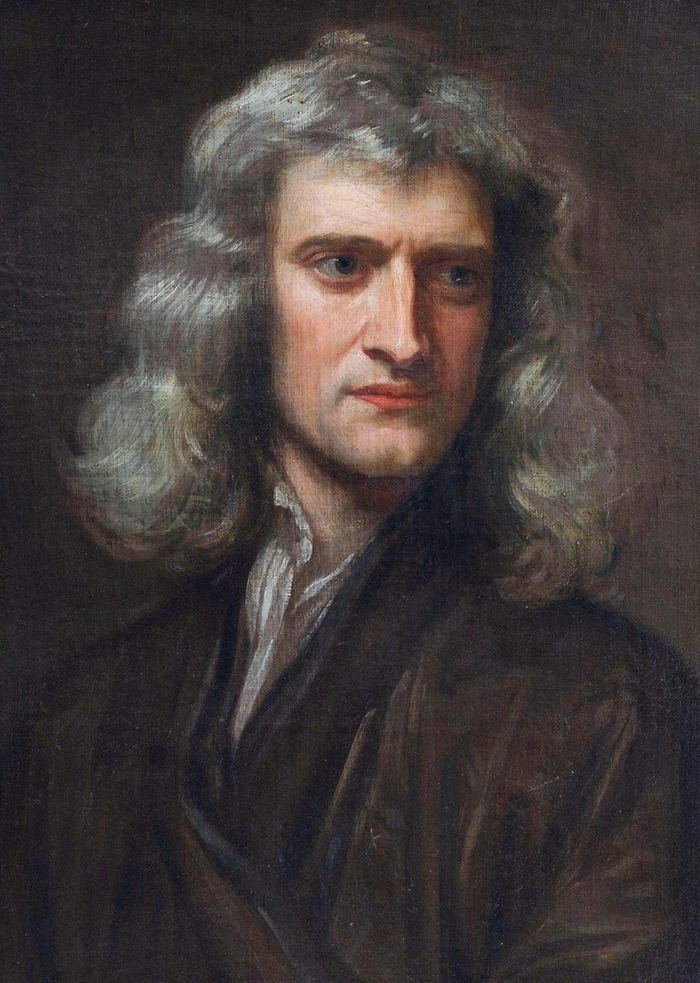
Isaac Newton in 1689, by Godfrey Kneller — the earliest known portrait. He is 47. Twenty-three years earlier, in 1666, he shut himself in the dark for three days after looking at the Sun in a mirror.
In 1664, Robert Boyle had reported the case of a scholar who had damaged his eyes "by looking too fixedly upon the sun through a telescope, without any coloured glass to take off from the dazzling splendour of the object". Nine or ten years after the accident, that man still saw passing before his eyes, whenever he turned towards a window, "a globe of light of about the bigness the sun then appeared to him"18. We would call that a solar retinopathy today, and the nine-year delay says plainly enough that it was permanent.
The case intrigued John Locke, who wrote to Newton for his opinion. Newton replied from Cambridge on 30 June 1691 that he had made the experiment on himself — "with the hazard of my eyes". Around 1666, when he was twenty-three, he had looked at the reflection of the Sun in a mirror, then started again, then again, to study after-images:
And now, in a few hours' time, I had brought my eyes to such a pass, that I could look upon no bright object with either eye, but I saw the sun before me, so that I durst neither write nor read ; but to recover the use of my eyes, shut myself up in my chamber made dark, for three days together, and used all means to divert my imagination from the sun.19
The rest of the letter is more troubling still. Newton recovered the use of his eyes in three or four days, but for months afterwards the spectre of the Sun came back "as often as I began to meditate upon the phenomena, even though I lay in bed at midnight with my curtains drawn".
There was no eclipse to look at, and he knew exactly what he was doing. It is the best demonstration one could give of the first sentence of this article: the retina gives no warning.
Chris Y. Wu et al., “Acute Solar Retinopathy Imaged With Adaptive Optics, Optical Coherence Tomography Angiography, and En Face Optical Coherence Tomography,” JAMA Ophthalmology 136 (2018): 82–85, https://doi.org/10.1001/jamaophthalmol.2017.5517. ↩
Coulombier et al., Complications oculaires de l'éclipse du 11 août 1999. ↩
Samuel C. K. Wong, Tom Eke, and N. G. Ziakas, “Eclipse burns: a prospective study of solar retinopathy following the 1999 solar eclipse,” The Lancet 357 (2001): 199–200, https://doi.org/10.1016/S0140-6736(00)03597-2; Tom Eke and Samuel C. K. Wong, “Resolution of visual symptoms in eclipse retinopathy,” The Lancet 358 (2001): 674, https://doi.org/10.1016/S0140-6736(01)05813-5. ↩
Qais A. Dihan et al., “Eye on the Eclipse: Demographic Trends in Solar Retinopathy From 2012 to 2024,” Journal of VitreoRetinal Diseases (2026), https://doi.org/10.1177/24741264261447500. ↩
Christopher Ricks, Alexandrea Montoya, and Jeff Pettey, “The ophthalmic fallout in Utah after the Great American Solar Eclipse of 2017,” Clinical Ophthalmology 12 (2018): 1853–1857, https://doi.org/10.2147/OPTH.S174808. ↩
American Astronomical Society, “About the ISO 12312-2 Standard for Solar Viewers,”, Solar Eclipse Across America, https://eclipse.aas.org/eye-safety/iso12312-2 (accessed 10 septembre 2026). ↩
Coulombier et al., Complications oculaires de l'éclipse du 11 août 1999. ↩
Parlement européen et Conseil de l'Union européenne, Règlement (UE) 2016/425 du 9 mars 2016 relatif aux équipements de protection individuelle (2016). ↩
American Astronomical Society “ISO 12312-2 Standard for Solar Viewers,” ↩
Coulombier et al., Complications oculaires de l'éclipse du 11 août 1999. ↩
Andrew T. Young, “Eye problems of other early solar observers,”, San Diego State University, https://aty.sdsu.edu/vision/others.html (accessed 10 septembre 2026). ↩
Robert Boyle, Experiments and Considerations touching Colours (Londres: Henry Herringman, 1664). ↩
Isaac Newton, Lettre à John Locke, Cambridge, 30 juin 1691, dans David Brewster, Memoirs of the Life, Writings, and Discoveries of Sir Isaac Newton, vol. I (Édimbourg: Thomas Constable, 1855). ↩
Bibliography
American Astronomical Society. “About the ISO 12312-2 Standard for Solar Viewers.” Solar Eclipse Across America. https://eclipse.aas.org/eye-safety/iso12312-2. Accessed 10 septembre 2026.
Boyle, Robert. Experiments and Considerations touching Colours. Londres: Henry Herringman, 1664.
Dihan, Qais A., Andrew D. Brown, Nayef Alshammari, Ahmed F. Shakarchi, Muhammad Z. Chauhan, and Ahmed B. Sallam. “Eye on the Eclipse: Demographic Trends in Solar Retinopathy From 2012 to 2024.” Journal of VitreoRetinal Diseases (2026). https://doi.org/10.1177/24741264261447500.
Michaelides, M., R. Rajendram, J. Marshall, and S. Keightley. “Eclipse retinopathy.” Eye 15 (2001): 148–151. https://doi.org/10.1038/eye.2001.49.
Newton, Isaac. Lettre à John Locke, Cambridge, 30 juin 1691, dans David Brewster, Memoirs of the Life, Writings, and Discoveries of Sir Isaac Newton, vol. I. Édimbourg: Thomas Constable, 1855. https://archive.org/details/memoirsoflifewri01brewuoft.
Ricks, Christopher, Alexandrea Montoya, and Jeff Pettey. “The ophthalmic fallout in Utah after the Great American Solar Eclipse of 2017.” Clinical Ophthalmology 12 (2018): 1853–1857. https://doi.org/10.2147/OPTH.S174808.
Wong, Samuel C. K., Tom Eke, and N. G. Ziakas. “Eclipse burns: a prospective study of solar retinopathy following the 1999 solar eclipse.” The Lancet 357 (2001): 199–200. https://doi.org/10.1016/S0140-6736(00)03597-2.
Wu, Chris Y., Michael E. Jansen, Jorge Andrade, Toco Y. P. Chui, Anna T. Do, Richard B. Rosen, and Avnish Deobhakta. “Acute Solar Retinopathy Imaged With Adaptive Optics, Optical Coherence Tomography Angiography, and En Face Optical Coherence Tomography.” JAMA Ophthalmology 136 (2018): 82–85. https://doi.org/10.1001/jamaophthalmol.2017.5517.
Young, Andrew T. “Eye problems of other early solar observers.” San Diego State University. https://aty.sdsu.edu/vision/others.html. Accessed 10 septembre 2026.