Novilune — solar eclipses: history, astronomy, observing
Solar eclipse · Saturday 6 February 2027 · Yamoussoukro, Ivory Coast

Partial eclipse in Yamoussoukro, 6 February 2027

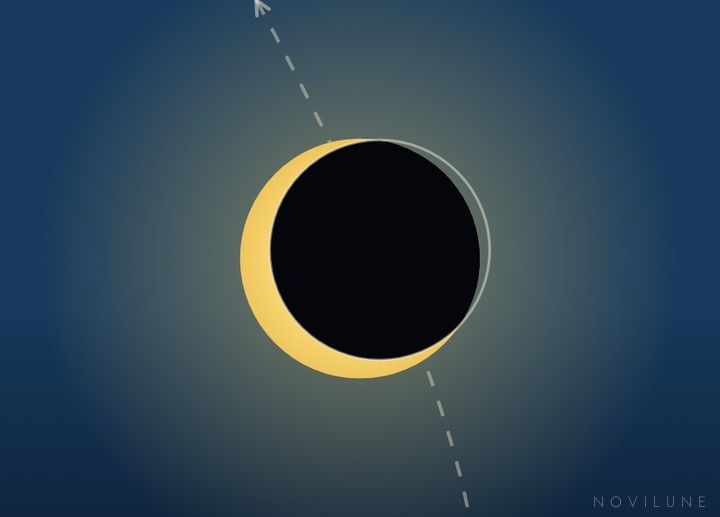
The Moon will cover at most 80% of the solar disc (magnitude 0.869), at 17:53:53 (local time in Abidjan). The Sun will then stand 8° above the horizon, towards the west-south-west. There is no totality here.

The path near you
Yamoussoukro lies outside the path of annularity. Its edge runs 201 km towards the south-south-east, near Dabou — that is where you have to stand to see the ring close.

eclipse path Novilune (map Natural Earth and GeoNames)

  • path of annularity
  • centre line
  • Yamoussoukro
  • sees the ring
  • partial eclipse only
Yamoussoukro lies outside the path of annularity. Its edge runs 201 km towards the south-south-east, near Dabou — that is where you have to stand to see the ring close.
The times, for Yamoussoukro
PhaseLocal timeUTSun's altitudealt.
First contact — the Moon touches the Sun16:41:0416:41:0425°
Maximum17:53:5317:53:53
Last contact — the Moon leaves the Sun18:58:0018:58:00below the horizon
What you will see
Maximum as seen from Yamoussoukro, drawn by Novilune.

For about two hours the Moon eats into the solar disc and then releases it. To the naked eye the drop in light is hardly noticeable until three quarters of the Sun are covered; here, at maximum, 80% of the disc will be hidden. The drop in light will be noticeable to anyone paying attention, no more than that.

To see totality you must be inside the path of totality — the eclipse map and the list of cities on the eclipse page show where it runs.

In Yamoussoukro, on 6 February 2027, there is no moment at which the Sun can be looked at without protection: eclipse glasses (ISO 12312-2) or projection onto a sheet of paper, from first to last contact.

How to look without burning your eyes →

The eclipse worldwide
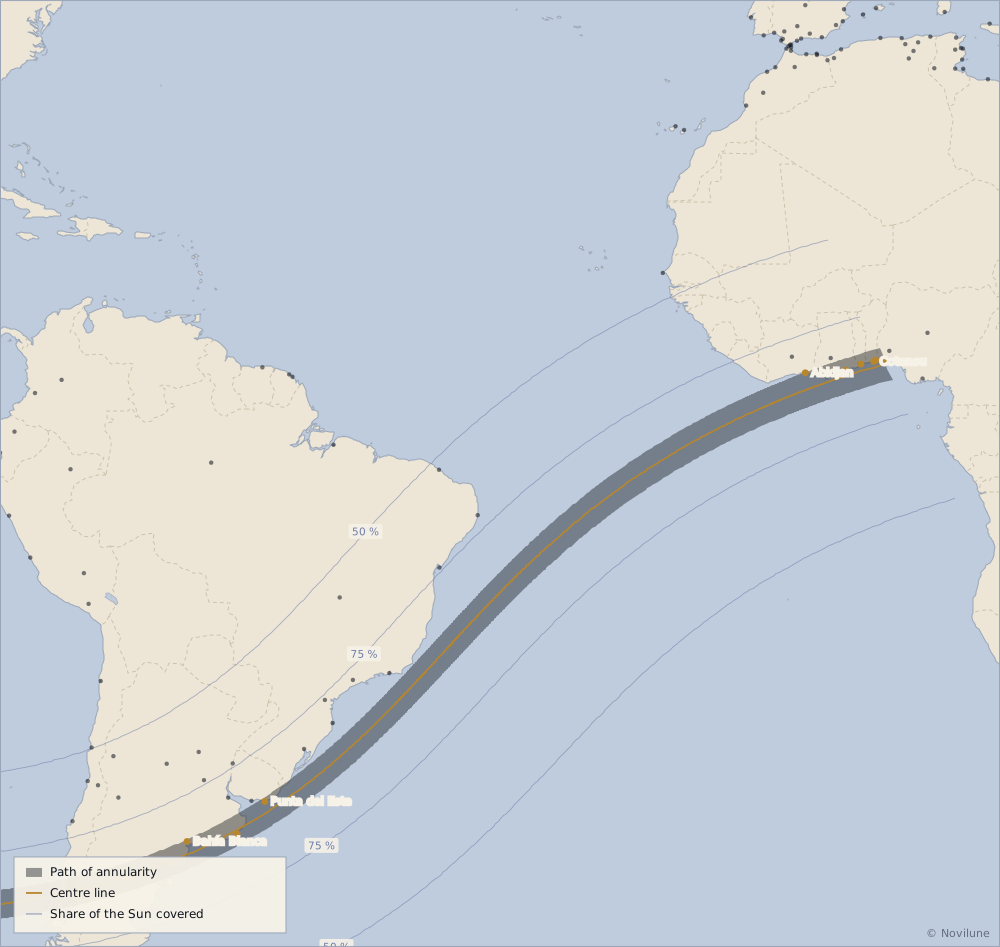
Where the eclipse passes. The golden dots mark the towns that see the central phase, the dark ones those where the Sun is only partly hidden. Map computed by Novilune.
Where these figures come from

Times and geometry computed by Novilune for the point 6.8200° N, 5.2776° W (altitude 212 m), from the Jet Propulsion Laboratory's DE441 ephemeris, with ΔT = 69.2 s. The uncertainty on ΔT (± 5 s) shifts all the times together by a few seconds at most; atmospheric refraction is not applied (it does not change the contact times appreciably at this altitude of the Sun).

Times are given in local time in Abidjan (UT +00:00).

In the app

Novilune draws this eclipse as it will be seen from Yamoussoukro — the two discs at maximum, the Moon's path, the map of the path of totality — and does the same for every new moon from 2000 BC to AD 3000, for any place on Earth, offline.

View on Google Play Android · free from 1900 to 2100

All cities, the map and the path of totality →

Also computed for this eclipse