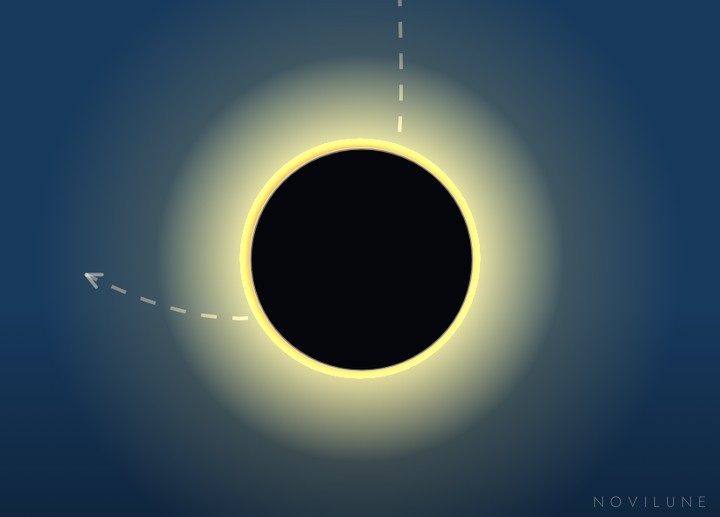
The Moon, slightly too small to cover the Sun, will leave a ring of it for 7 min 38 s, from 12:24:24 to 12:32:03 (local time in Buenos Aires). At maximum, at 12:28:14, the Sun will stand 66° above the horizon, towards the north-north-east.
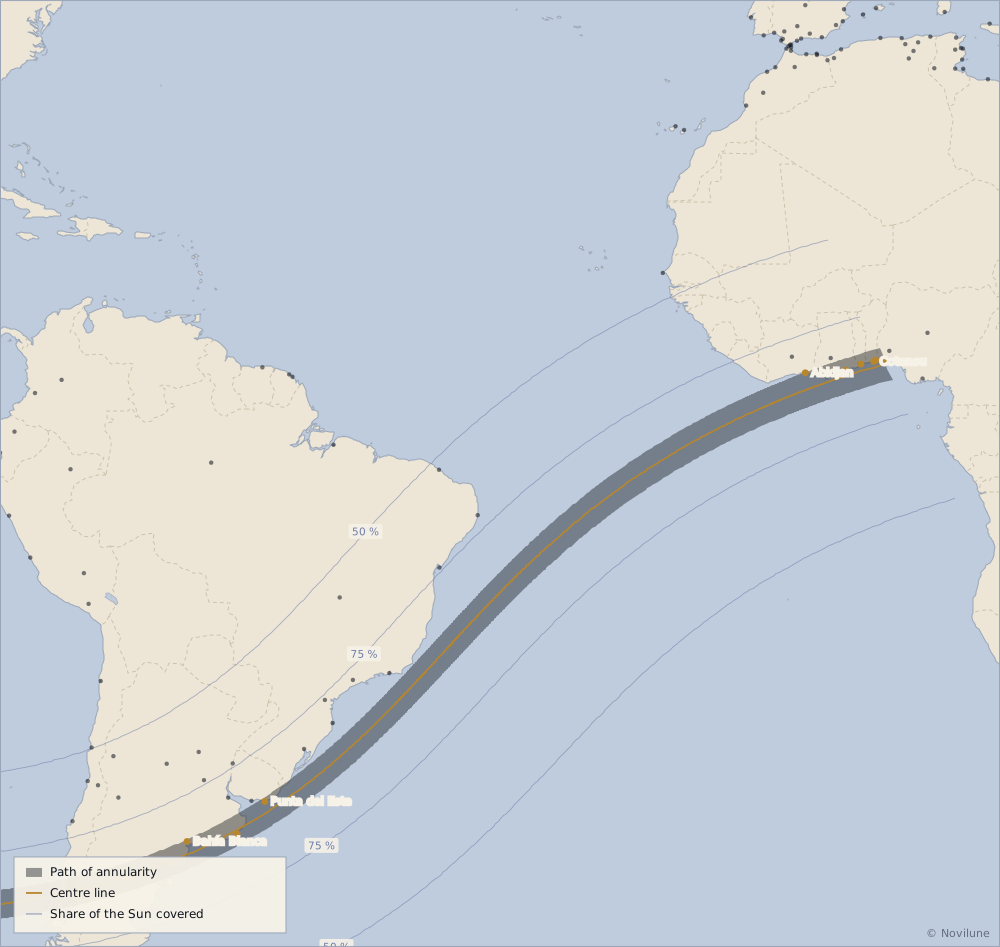
eclipse path Novilune (map Natural Earth and GeoNames)
| Phase | Local time | UT | Sun's altitudealt. |
|---|---|---|---|
| First contact — the Moon touches the Sun | 10:45:23 | 13:45:23 | 52° |
| Annularity begins | 12:24:24 | 15:24:24 | 66° |
| Maximum | 12:28:14 | 15:28:14 | 66° |
| Annularity ends | 12:32:03 | 15:32:03 | 66° |
| Last contact — the Moon leaves the Sun | 14:10:10 | 17:10:10 | 63° |

That day the Moon is slightly too far from the Earth to cover the whole Sun: at maximum it leaves a bright ring. The sky darkens noticeably but never becomes night, and eye protection remains necessary from start to finish, ring included.
The annular phase lasts 7 min 38 s, from 12:24:24 to 12:32:03; the partial phase ends at 14:10:10.
Times and geometry computed by Novilune for the point 37.9976° S, 57.5482° W (altitude 28 m), from the Jet Propulsion Laboratory's DE441 ephemeris, with ΔT = 69.2 s. The uncertainty on ΔT (± 5 s) shifts all the times together by a few seconds at most; atmospheric refraction is not applied (it does not change the contact times appreciably at this altitude of the Sun).
Times are given in local time in Buenos Aires (UT -03:00).
Novilune draws this eclipse as it will be seen from Mar del Plata — the two discs at maximum, the Moon's path, the map of the path of totality — and does the same for every new moon from 2000 BC to AD 3000, for any place on Earth, offline.
Bahía Blanca · Buenos Aires · Córdoba · Mendoza · Rosario · San Juan · Santa Fe
Belém · Brasília · Curitiba · Florianópolis · Fortaleza · Porto Alegre · Recife · Rio de Janeiro · Salvador · São Paulo
Antofagasta · Concepción · La Serena · Santiago · Valparaíso
Abuja · Ibadan · Lagos · Port Harcourt