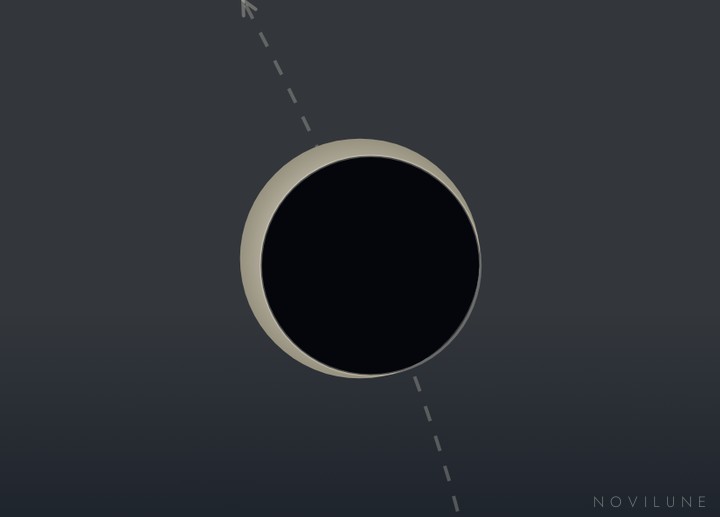
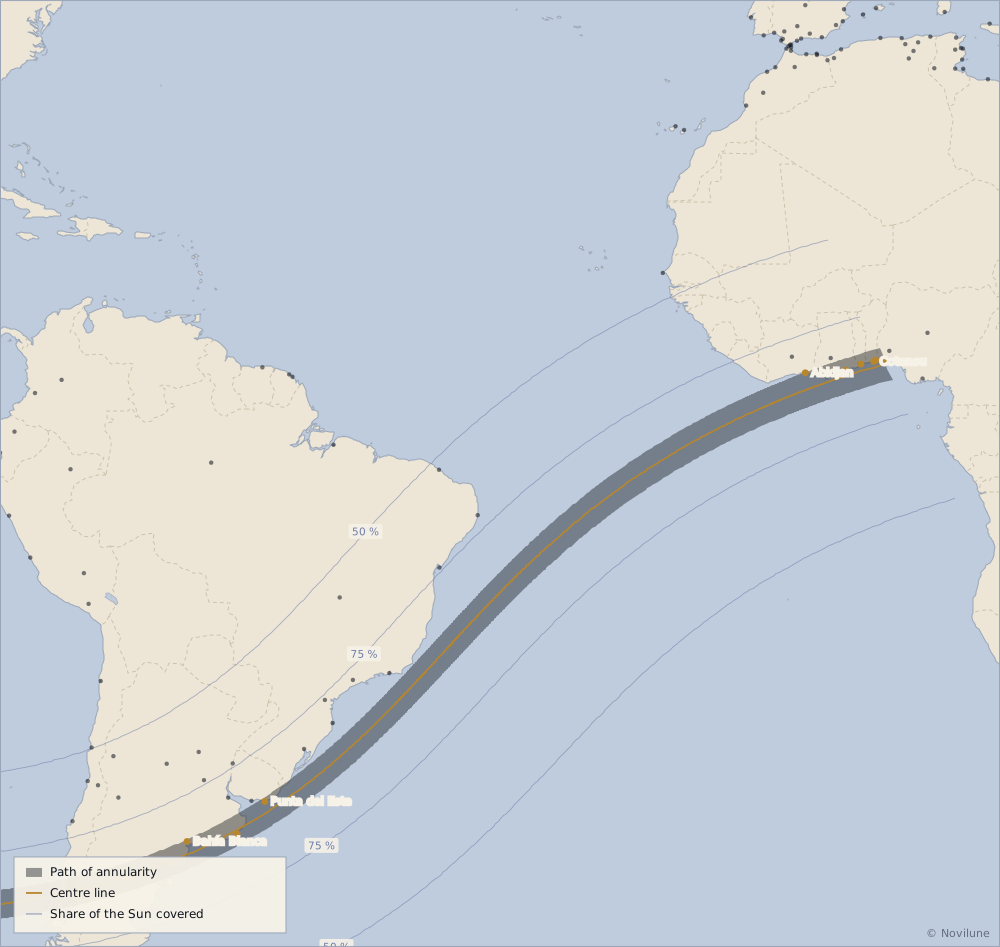
The eclipse begins at 17:45:05, with the Sun still 15° above the horizon. It goes on as the Sun descends, and the Sun sets at 18:50:11 with 83% of the disc covered. The rest — including maximum — happens below the horizon: it cannot be observed here.
eclipse path Novilune (map Natural Earth and GeoNames)
| Phase | Local time | UT | Sun's altitudealt. |
|---|---|---|---|
| First contact — the Moon touches the Sun | 17:45:05 | 16:45:05 | 15° |
| Sunset — the rest is below the horizon | 18:50:11 | 17:50:11 | 0° |
| Annularity begins | 18:51:03 | 17:51:03 | below the horizon |
| Annularity ends | 18:55:16 | 17:55:16 | below the horizon |
| Last contact — the Moon leaves the Sun | 19:53:56 | 18:53:56 | below the horizon |

Ibadan does lie inside the band where the ring is visible. It makes no difference: the ring forms there after sunset, so nobody will see it from Ibadan. To see it you must be further west, where the Sun is still up at that moment.
Look west, and low. During the hour before sunset the Moon bites deeper and deeper into the Sun; this is the finest moment, because the Sun is already red and low — and because a notched Sun sitting on a clear horizon is far more striking than a crescent high in the sky.
A completely clear view to the west is essential: a hill, a building or a line of trees is enough to hide everything. The sea, a plain or a summit are the best vantage points.
Eye protection remains necessary as long as any part of the Sun shows, including at the very horizon: a setting Sun looks harmless, and is not.
Times and geometry computed by Novilune for the point 7.3784° N, 3.8972° E (altitude 219 m), from the Jet Propulsion Laboratory's DE441 ephemeris, with ΔT = 69.2 s. The uncertainty on ΔT (± 5 s) shifts all the times together by a few seconds at most; atmospheric refraction is not applied (it does not change the contact times appreciably at this altitude of the Sun).
Times are given in local time in Lagos (UT +01:00).
Novilune draws this eclipse as it will be seen from Ibadan — the two discs at maximum, the Moon's path, the map of the path of totality — and does the same for every new moon from 2000 BC to AD 3000, for any place on Earth, offline.
Bahía Blanca · Buenos Aires · Córdoba · Mar del Plata · Mendoza · Rosario · San Juan · Santa Fe
Belém · Brasília · Curitiba · Florianópolis · Fortaleza · Porto Alegre · Recife · Rio de Janeiro · Salvador · São Paulo
Antofagasta · Concepción · La Serena · Santiago · Valparaíso
Abuja · Lagos · Port Harcourt