
Partial eclipse in San Juan, 26 January 2028
The Moon will cover at most 11% of the solar disc (magnitude 0.205), at 10:46:19 (local time in San Juan). The Sun will then stand 47° above the horizon, towards the east. There is no totality here.
The Moon will cover at most 11% of the solar disc (magnitude 0.205), at 10:46:19 (local time in San Juan). The Sun will then stand 47° above the horizon, towards the east. There is no totality here.
| Phase | Local time | UT | Sun's altitudealt. |
|---|---|---|---|
| First contact — the Moon touches the Sun | 09:49:53 | 12:49:53 | 35° |
| Maximum | 10:46:19 | 13:46:19 | 47° |
| Last contact — the Moon leaves the Sun | 11:48:07 | 14:48:07 | 60° |
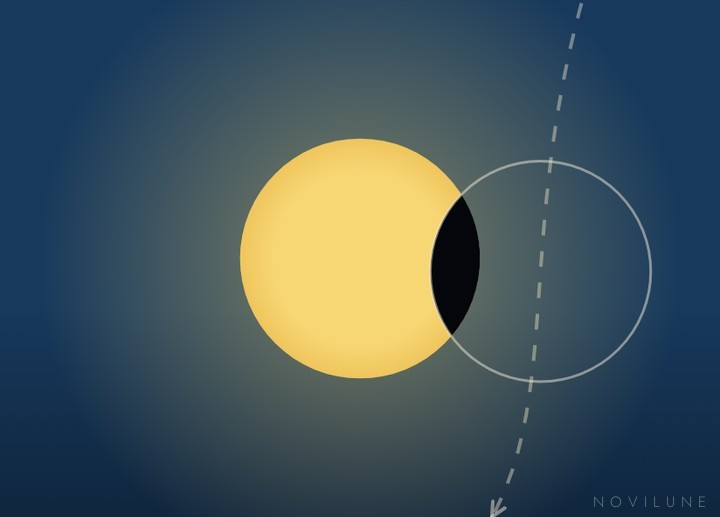
For about two hours the Moon eats into the solar disc and then releases it. To the naked eye the drop in light is hardly noticeable until three quarters of the Sun are covered; here, at maximum, 11% of the disc will be hidden. Without an instrument or eclipse glasses, nothing will be noticed.
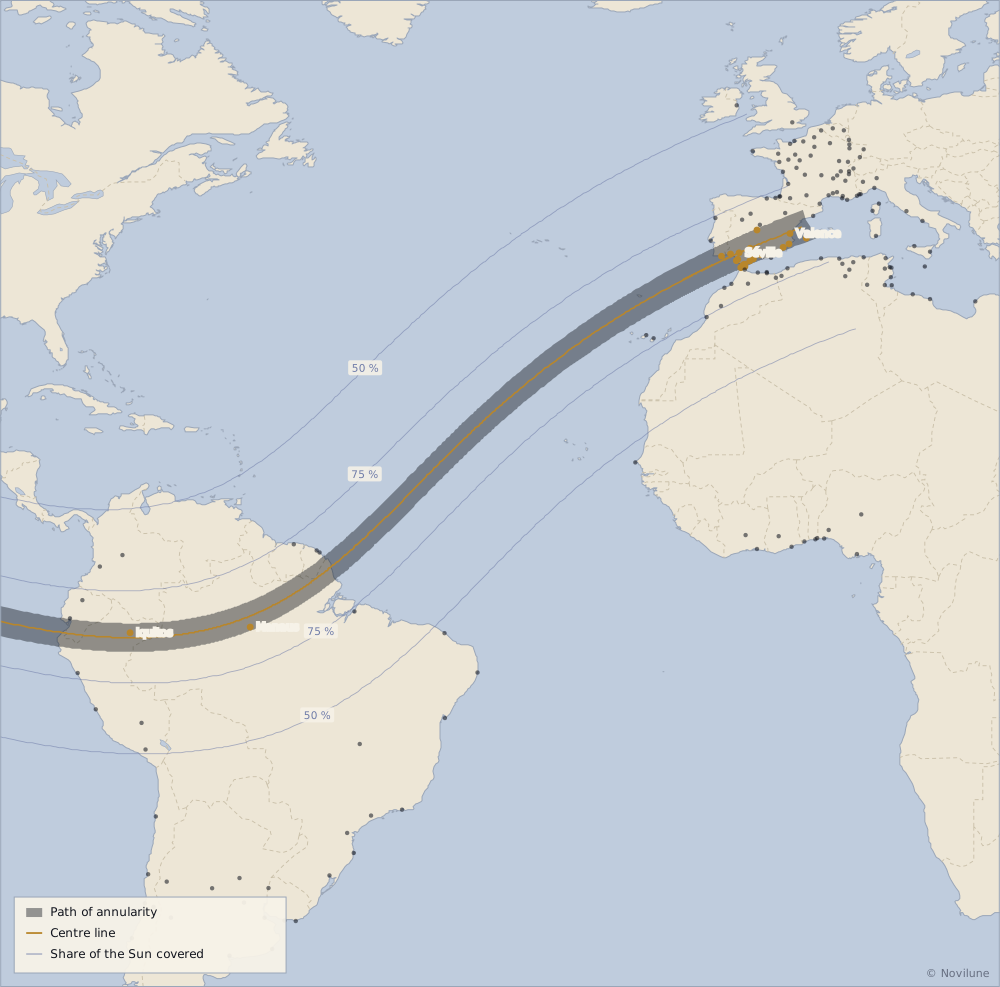
To see totality you must be inside the path of totality — the eclipse map and the list of cities on the eclipse page show where it runs.
In San Juan, on 26 January 2028, there is no moment at which the Sun can be looked at without protection: eclipse glasses (ISO 12312-2) or projection onto a sheet of paper, from first to last contact.
Times and geometry computed by Novilune for the point 30.7054° S, 69.1988° W (altitude 2408 m), from the Jet Propulsion Laboratory's DE441 ephemeris, with ΔT = 69.3 s. The uncertainty on ΔT (± 6 s) shifts all the times together by a few seconds at most; atmospheric refraction is not applied (it does not change the contact times appreciably at this altitude of the Sun).
Times are given in local time in San Juan (UT -03:00).
Novilune draws this eclipse as it will be seen from San Juan — the two discs at maximum, the Moon's path, the map of the path of totality — and does the same for every new moon from 2000 BC to AD 3000, for any place on Earth, offline.
Belém · Brasília · Curitiba · Fortaleza · Manaus · Recife · Rio de Janeiro · Salvador · São Paulo
Agadir · Al Hoceima · Casablanca · Fez · Marrakesh · Nador · Oujda · Rabat · Tangier · Tetouan
Algeciras · Alicante · Almería · Barcelona · Bilbao · Cádiz · Ceuta · Córdoba · Granada · Huelva · Ibiza · Jerez de la Frontera · Las Palmas de Gran Canaria · Madrid · Málaga · Marbella · Melilla · Murcia · Palma de Mallorca · Salamanca · San Sebastián · Santa Cruz de Tenerife · Seville · Tarifa · Toledo · Valencia · Valladolid · Zaragoza