Novilune — solar eclipses: history, astronomy, observing
Solar eclipse · Wednesday 26 January 2028 · Algeciras, Spain

Annular eclipse in Algeciras, 26 January 2028

The Moon, slightly too small to cover the Sun, will leave a ring of it for 4 min 12 s, from 17:54:25 to 17:58:37 (local time in Madrid). At maximum, at 17:56:31, the Sun will stand 7° above the horizon, towards the west-south-west.

The path near you
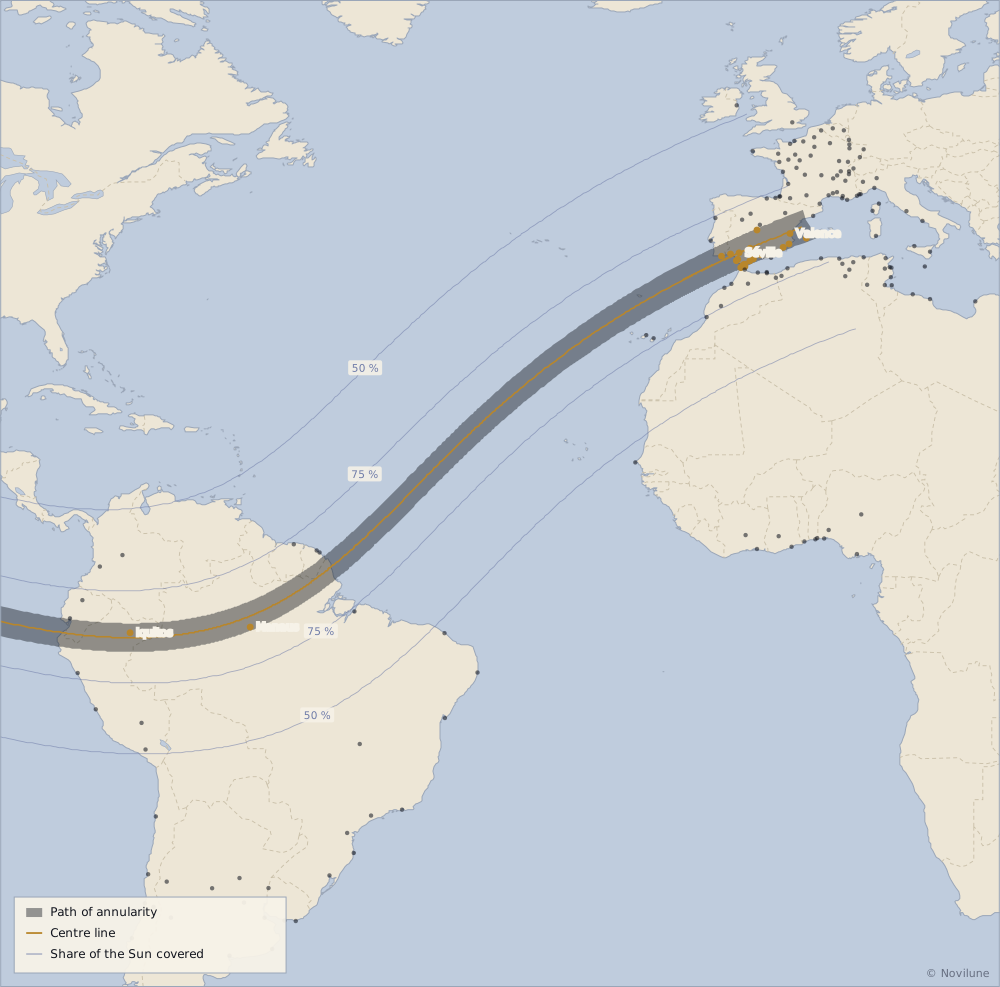
Algeciras lies inside the path of annularity, 30 km from its nearest edge, towards the south-south-east. Beyond that line the ring no longer closes. The centre line, where the ring lasts longest, runs 144 km further towards the north-north-west.

eclipse path Novilune (map Natural Earth and GeoNames)

  • path of annularity
  • centre line
  • Algeciras
  • sees the ring
  • partial eclipse only
Algeciras lies inside the path of annularity, 30 km from its nearest edge, towards the south-south-east. Beyond that line the ring no longer closes. The centre line, where the ring lasts longest, runs 144 km further towards the north-north-west.
The times, for Algeciras
PhaseLocal timeUTSun's altitudealt.
First contact — the Moon touches the Sun16:35:1215:35:1220°
Annularity begins17:54:2516:54:25
Maximum17:56:3116:56:31
Annularity ends17:58:3716:58:37
Last contact — the Moon leaves the Sun19:08:0818:08:08below the horizon
What you will see
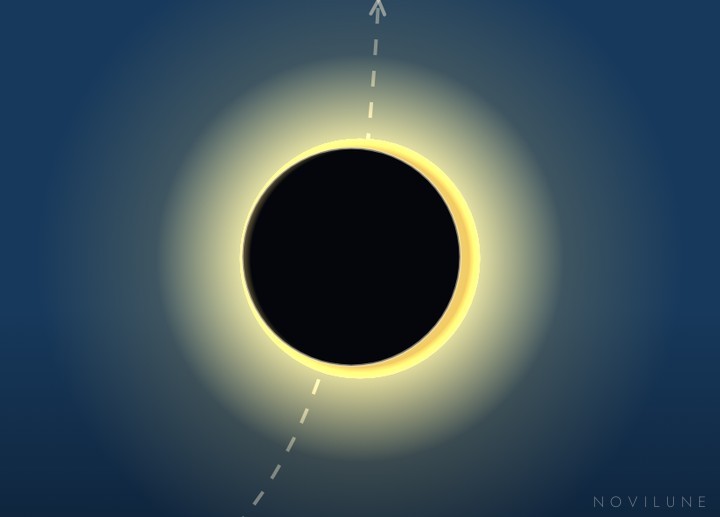
Maximum as seen from Algeciras, drawn by Novilune.

Mind the altitude of the Sun: it will stand only 7° above the horizon, towards the west-south-west. You need a completely clear view that way — a hill, a building or a line of trees is enough to hide everything.

That day the Moon is slightly too far from the Earth to cover the whole Sun: at maximum it leaves a bright ring. The sky darkens noticeably but never becomes night, and eye protection remains necessary from start to finish, ring included.

The annular phase lasts 4 min 12 s, from 17:54:25 to 17:58:37; the partial phase ends at 19:08:08.

How to look without burning your eyes →

The eclipse worldwide
Where the eclipse passes. The golden dots mark the towns that see the central phase, the dark ones those where the Sun is only partly hidden. Map computed by Novilune.
Where these figures come from

Times and geometry computed by Novilune for the point 36.1312° N, 5.4474° W (altitude 26 m), from the Jet Propulsion Laboratory's DE441 ephemeris, with ΔT = 69.3 s. The uncertainty on ΔT (± 6 s) shifts all the times together by a few seconds at most; atmospheric refraction is not applied (it does not change the contact times appreciably at this altitude of the Sun).

Times are given in local time in Madrid (UT +01:00).

In the app

Novilune draws this eclipse as it will be seen from Algeciras — the two discs at maximum, the Moon's path, the map of the path of totality — and does the same for every new moon from 2000 BC to AD 3000, for any place on Earth, offline.

View on Google Play Android · free from 1900 to 2100

All cities, the map and the path of totality →

Also computed for this eclipse