
Total eclipse in Katoomba, 22 July 2028
The Sun will be completely hidden for 3 min 30 s, from 13:58:30 to 14:02:00 (local time in Sydney). At maximum, at 14:00:15, it will stand 30° above the horizon, towards the north-north-west.
The Sun will be completely hidden for 3 min 30 s, from 13:58:30 to 14:02:00 (local time in Sydney). At maximum, at 14:00:15, it will stand 30° above the horizon, towards the north-north-west.
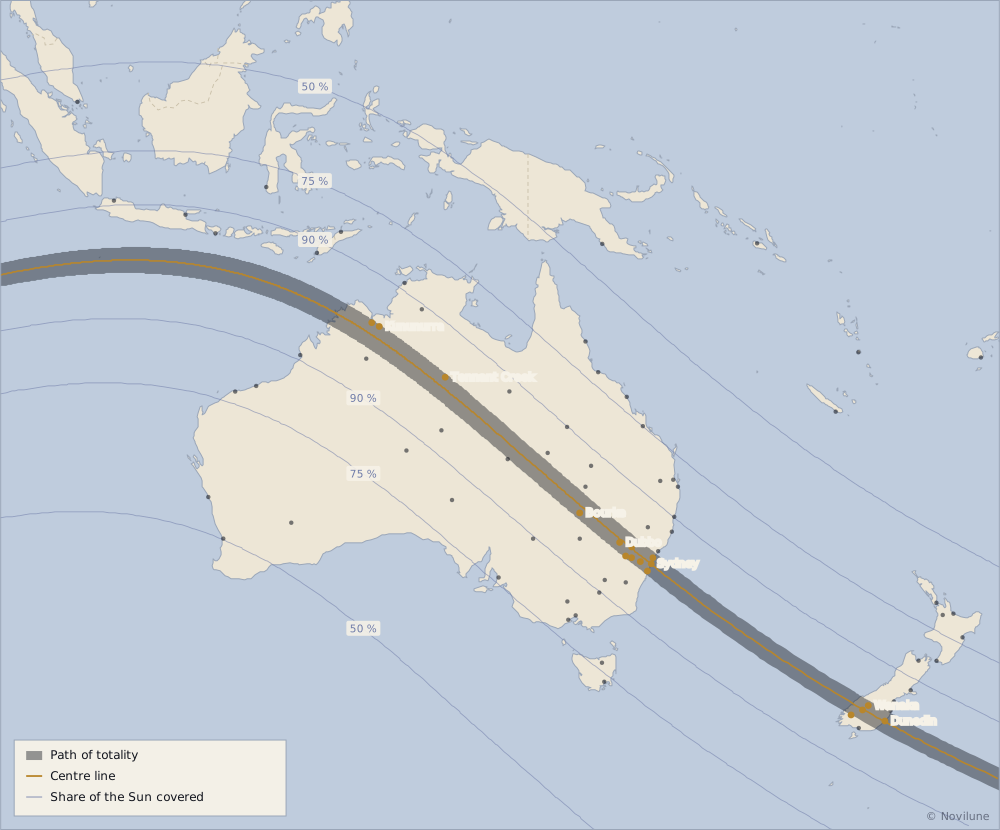
eclipse path Novilune (map Natural Earth and GeoNames)
| Phase | Local time | UT | Sun's altitudealt. |
|---|---|---|---|
| First contact — the Moon touches the Sun | 12:39:00 | 02:39:00 | 36° |
| Totality begins | 13:58:30 | 03:58:30 | 30° |
| Maximum | 14:00:15 | 04:00:15 | 30° |
| Totality ends | 14:02:00 | 04:02:00 | 29° |
| Last contact — the Moon leaves the Sun | 15:13:57 | 05:13:57 | 20° |
For a little over an hour, the Moon slowly bites into the Sun: to the naked eye nothing changes until more than three quarters of the disc are covered. Then the light drops quickly, shadows sharpen, the temperature falls.
At 13:58:30, the last sliver of Sun goes out. For 3 min 30 s you may look without protection: the corona appears around the black disc of the Moon, the brightest planets come out, the horizon takes on twilight colours all around. It is the only moment when eclipse glasses come off — and they go back on the instant the first ray returns, at 14:02:00.
The partial phase ends at 15:13:57.
Times and geometry computed by Novilune for the point 33.7140° S, 150.3116° E (altitude 1027 m), from the Jet Propulsion Laboratory's DE441 ephemeris, with ΔT = 69.4 s. The uncertainty on ΔT (± 6 s) shifts all the times together by a few seconds at most; atmospheric refraction is not applied (it does not change the contact times appreciably at this altitude of the Sun).
Times are given in local time in Sydney (UT +10:00).
Novilune draws this eclipse as it will be seen from Katoomba — the two discs at maximum, the Moon's path, the map of the path of totality — and does the same for every new moon from 2000 BC to AD 3000, for any place on Earth, offline.
Adelaide · Albury · Alice Springs · Bathurst · Bendigo · Birdsville · Bourke · Brisbane · Broken Hill · Broome · Cairns · Canberra · Charleville · Cobar · Coffs Harbour · Coober Pedy · Cunnamulla · Darwin · Dubbo · Geelong · Geraldton · Gold Coast · Gosford · Halls Creek · Hobart · Kalgoorlie · Karratha · Katherine · Kununurra · Launceston · Longreach · Mackay · Melbourne · Mount Isa · Mudgee · Newcastle · Orange · Perth · Port Hedland · Port Macquarie · Rockhampton · Sydney · Tamworth · Tennant Creek · Toowoomba · Townsville · Wagga Wagga · Windorah · Wollongong · Wyndham · Yulara (Uluru)
Auckland · Christchurch · Dunedin · Hamilton · Invercargill · Napier · Nelson · Oamaru · Queenstown · Tauranga · Te Anau · Timaru · Wanaka · Wellington